PiCK
「ウォン建てステーブルコイン、リショアリングを超えてグローバル金融への飛躍の鍵」
概要
- Academic and industry experts stated that the issuance of a won-based stablecoin and the establishment of a derivatives system are essential for the survival of the Korean financial system and for securing global competitiveness.
- Kang Byeong-ha of Meritz Securities and Kim Ho-jin of Shard Lab emphasized that the won-based stablecoin could become a core infrastructure for attracting global investors and industrial development.
- Jo Jin-seok of KODA and Ryu Hyuk-seon of KAIST warned that without institutional improvements, the corporate market may be taken over by foreign players, and highlighted the need for rapid institutional reform and real demand-based design.
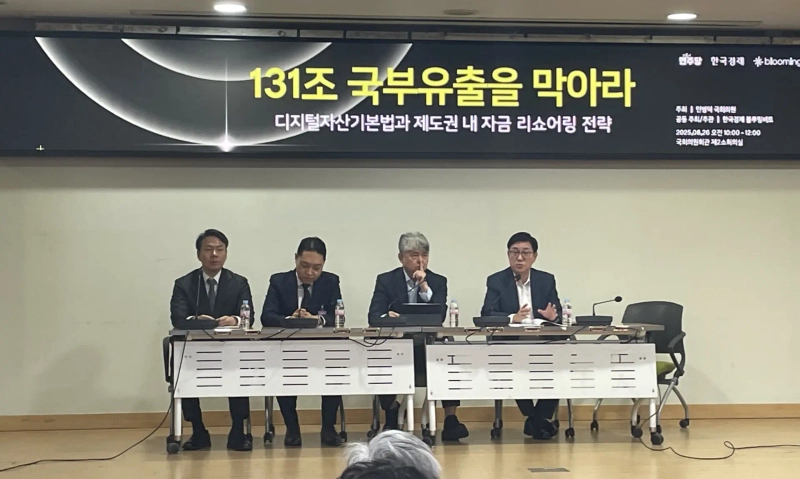
Academic and industry experts unanimously stated that the issuance of a won-based stablecoin and the establishment of a derivatives system are essential tasks for the survival of the Korean financial system and securing global competitiveness. The argument is that Korea must lead a new financial order through the establishment of stable infrastructure and proactive state-led design.
At the second panel discussion of the seminar held on the 26th at the National Assembly Members' Office Building in Seoul, titled 'Block 131 trillion won of national wealth outflow: Digital Asset Framework Act and Onshore Fund Re-shoring Strategy', Kang Byeong-ha, Executive Director at Meritz Securities, said, "A won-based stablecoin can have the effect of not only bringing back capital that has flowed overseas (re-shoring), but also attracting global investors and regions excluded from financial infrastructure into the domestic market." He added, "Users want stable stablecoins, but due to a lack of options, funds are flowing overseas to places like Singapore. If qualified operators build the infrastructure and provide stability based on existing trust, the technical barriers will not be high."
There is also a forecast that stablecoins will become the fundamental layer of future blockchain systems. Kim Ho-jin, CEO of Shard Lab, emphasized, "In the Web3 era, only countries that proactively establish the core layer of stablecoins will be able to foster new unicorns. Stablecoins play the role of operating systems (OS), like iOS or Google App Store in the mobile market. This will form the foundation not only for industrial development, but also for upcoming startups and ecosystem participants." He further stressed, "For this reason, stablecoins must be designed under national leadership."
Jo Jin-seok, CEO of KODA, pointed out, "In Korea, there are no markets for virtual asset-based lending, futures, and derivatives, so corporations cannot find hedging tools. If the system is not ready, the corporate market could be taken over by foreign players." He advised, "New business areas are expanding rapidly at a global level, and a perfectionist approach could lead to being left behind. A culture that values prompt response and improvement is needed."
Ryu Hyuk-seon, Professor at KAIST, stated, "Creating credit provision and derivatives markets for reshoring is not just an institutional improvement, but directly tied to the survival of the Republic of Korea's financial system. A won-based stablecoin should be designed not just for issuance, but to generate real demand." He emphasized, "Korea is already considered one of the world's top three countries in platforms, culture, and economic power; therefore, strategies to globalize these strengths are important. If the Wonsco (won-based stablecoin) market is properly established, it could open new opportunities based on reserve currency."

Minseung Kang
minriver@bloomingbit.ioBlockchain journalist | Writer of Trade Now & Altcoin Now, must-read content for investors.