WSJ "Korea, Japan 'U.S.-bound investment funds' may lead to bad investments and corruption…hearings likely"
概要
- The Wall Street Journal (WSJ) warned that President Trump's coercion of investment into the U.S. could lead to bad investments and political corruption.
- The WSJ pointed out that the multi-billion-dollar special purpose vehicle (SPV) investment structure grants the president unprecedented authority and raises the problem of lack of accountability to Congress and voters.
- The WSJ forecasted that this investment plan lacks financing realism and could face risks such as political pressure and hearings in the future.
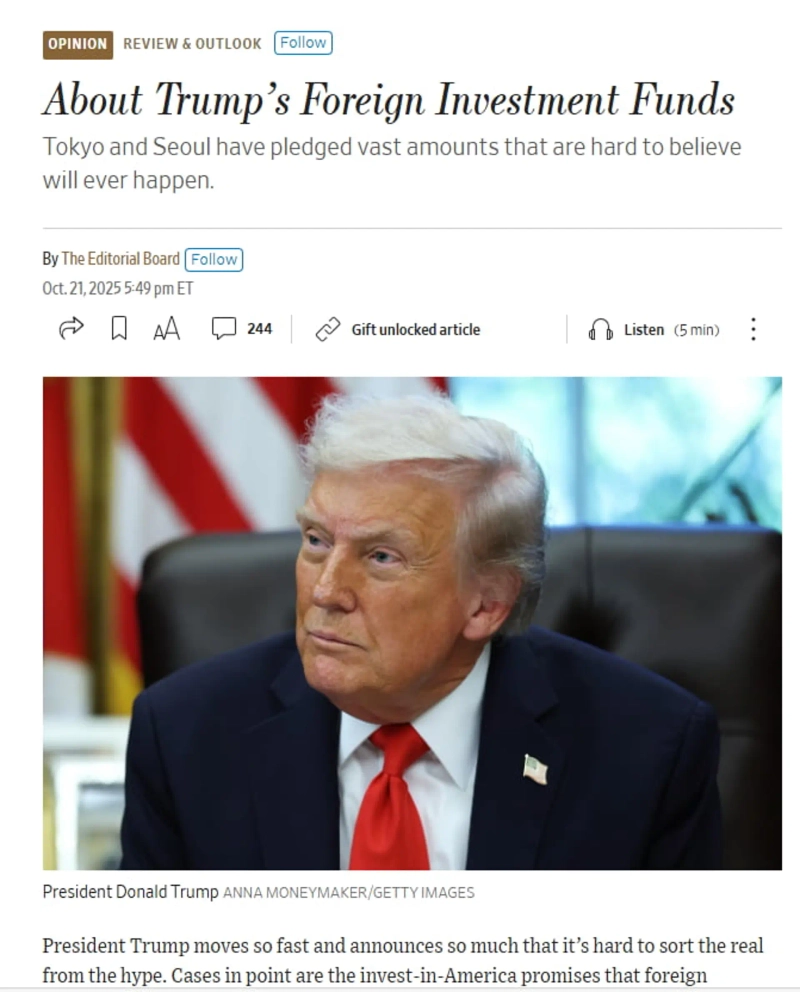
U.S. media has warned that forcing Korea and Japan to make large-scale investments in exchange for tariff cuts could lead to bad investments and corruption.
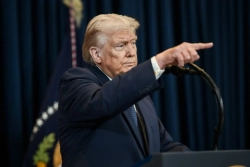
The Wall Street Journal (WSJ), in an editorial on the 21st (local time), pointed out that President Donald Trump's plan to secure $350 billion from Korea and $550 billion from Japan differs from typical investment into the U.S., and detailed the risks inherent in this investment structure.
The WSJ cited Japan, which signed an investment agreement (MOU), explaining that this is a peculiar form in which one country's government invests in another country's government rather than private company investment. It explained that for each investment a special purpose vehicle (SPV) would be established, chosen and controlled by the president or a manager he designates, and judged this to be "in effect a sovereign wealth fund operated without congressional appropriation or legislative procedures."
It went on, "The scale of such promises is itself too large," and analyzed that if the pledged money were to be spent over the next three years, that would amount to using 6.5% of Korea's gross domestic product (GDP) and 4.4% of Japan's GDP each year. The Japan Bank for International Cooperation (JBIC), which would be responsible for executing Japan's investments in the U.S., has assets of only $35 billion. The WSJ mocked Commerce Secretary Howard Lutnick's advice that Japan would have to "blow up its balance sheet" and borrow heavily to carry out the MOU as a "truly kind suggestion."
The WSJ wrote that, instead of forcing such investments, it might be a better choice to have the two countries increase their defense spending. This is because not only is the funding unrealistic, but officials in both countries, who must be accountable to voters and their parliaments, would find it difficult to fulfill the promises. The paper added that it would be hard to believe that Japan's new prime minister Sanae Takaichi, who just launched a coalition government as a minority party, "would write checks to a foreign government under these conditions."
Above all, the WSJ emphasized that this is likely to lead to political corruption. The WSJ said that allowing the president to spend billions of dollars at his discretion would be unprecedented, and predicted that Treasury Secretary Scott Bessent and Secretary Lutnick would "face enormous political pressure to invest in businesses run by people close to the president and the Republican Party."
The WSJ said that while the two governments may be hoping that unilateral tariff measures will ultimately be struck down by the Supreme Court, even in that case President Trump "could still use other tariff authorities to extort them," and "if a Democratic president had done this, Republicans would have called it unfair and held hearings." The WSJ critically forecasted, "Soon the Trump investment fund will also receive the same scrutiny (hearings) it rightly deserves."
Washington = Sang-eun Lee, correspondent selee@hankyung.com

Korea Economic Daily
hankyung@bloomingbit.ioThe Korea Economic Daily Global is a digital media where latest news on Korean companies, industries, and financial markets.