概要
- Attorney Han Seo-hee emphasized the need for legislation to make the Korean won stablecoin a means of protecting the national interest against dollarization.
- The four bills pending in the National Assembly have diverse capital requirements ranging from 500 million to 5 billion won, and the issuers are not limited to financial institutions.
- Researcher Kim Gap-rae warned that overseas, stablecoins are transforming payment and securities systems, and that Korea should not fall behind in institutionalization.
米・日・EUはすでに法制化・施行
国内では4つの法案が係留中、それぞれ異なる要件
自己資本は5億~50億まで大きな差
「通貨主権の強化手段」と強調
マネーロンダリング対策・ウォレットスクリーニング課題

"Stablecoins based on the Korean won are ultimately for the national interest, and it is necessary to enact legislation to use them as a means to prevent dollarization."
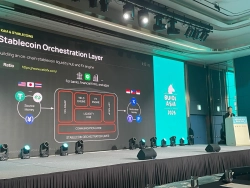
At the seminar "Global Regulatory Trends and Business of Stablecoins: Implications for Korea" held by Barun Law LLC's Digital Asset & Innovative Industry Team at the 2nd floor conference hall of Seoul Gangnam Textile Center Building on the afternoon of the 19th, Han Seo-hee, an attorney from Barun, emphasized the need for institutionalization of domestic stablecoins and stated so.
"Korean Won Stablecoin as a Means to Prevent Dollarization"
Approximately 80 experts from academia, industry, and the legal profession attended the seminar. In each session, Kim Gap-rae from the Capital Market Research Institute, attorney Han, Lee Seong-san, the Korea lead of Solana Superteam, and others discussed the current status of global stablecoin regulation, payment system structures, and directions for responses by domestic operators.
Attorney Han specifically pointed out the characteristics of the four bills pending in the National Assembly. Han explained, "The bill by Min Byung-deok requires a capital of 500 million won, Kang Jun-hyun's proposes 1 billion won, and the bill by Ahn Do-geol and Kim Eun-hye sets the threshold at over 5 billion won," adding, "There is no bill yet restricting issuers to only financial companies, and the issuance is open to various types of operators." The standards for issuers and capital requirements vary, making it difficult for the industry to prepare for changes in the system.
Han also pointed out that Korea is lagging behind in institutionalization compared to overseas. Han stated, "Japan has had legislation since 2019, and Europe—including MiCA—and the US already have complete legal frameworks, only pending enforcement," adding, "In Korea, bills are just now being introduced."
Advice was also provided for how domestic operators should respond going forward. Han said, "The proposed bills do not restrict issuers to only financial companies, allowing various entities to participate," and, "But as the capital requirements in the bills range from 500 million to 5 billion won, actual operators will need to carefully consider how to participate, watching for government and National Assembly discussions." Han continued, "If the capital requirement is low, sole issuance is possible, but if it increases to over 5 billion won, forming a consortium among banks, big tech, virtual asset service providers, or fintech companies becomes likely," and added, "It will also be necessary to establish anti-money laundering systems, install wallet screening functions, and select between public and private blockchains in advance."
Real-time Settlement and Peer-to-Peer Transactions, Even Changing Securities Systems

During the seminar, overseas examples of stablecoin systems were also introduced. The first presenter, Kim Gap-rae of the Capital Market Research Institute, emphasized actual operational cases of global stablecoin environments centered around the United States. Kim said, "Circle, the issuer of USDC, deposits its reserves with BlackRock's MMF, and anyone can verify the structure of on-chain assets in real-time," and, "Stablecoins are replacing backend payment environments cheaper and more efficiently than credit card networks, which users don’t find inconvenient."
Kim further explained, "Real-time settlement and low-cost, peer-to-peer structures are impacting not only payment networks but also securities trading systems," and, "In the US, stablecoins are already routinely used in transactions at the fractional investment level, and in this growing market, USDC is essentially the only one being used." Kim warned, "Innovation happens like water boiling in a kettle—when the moment arrives, it suddenly changes the market, and if you then try to create new regulation, it will already be too late."
The final presenter, Lee, introduced examples of technological implementations using stablecoins. Demonstrating NFT commerce based on domestically and internationally issued stablecoins and cross-border remittance projects, Lee said, "It is quite feasible to implement stablecoin payment systems using smart contracts and decentralized verification in Korea as well." He especially emphasized that using deposit-based pegging structures and multi-signature schemes on domestic platforms enables both security and transparency.
Hwang Dong-jin reporter radhwang@hankyung.com

Korea Economic Daily
hankyung@bloomingbit.ioThe Korea Economic Daily Global is a digital media where latest news on Korean companies, industries, and financial markets.